


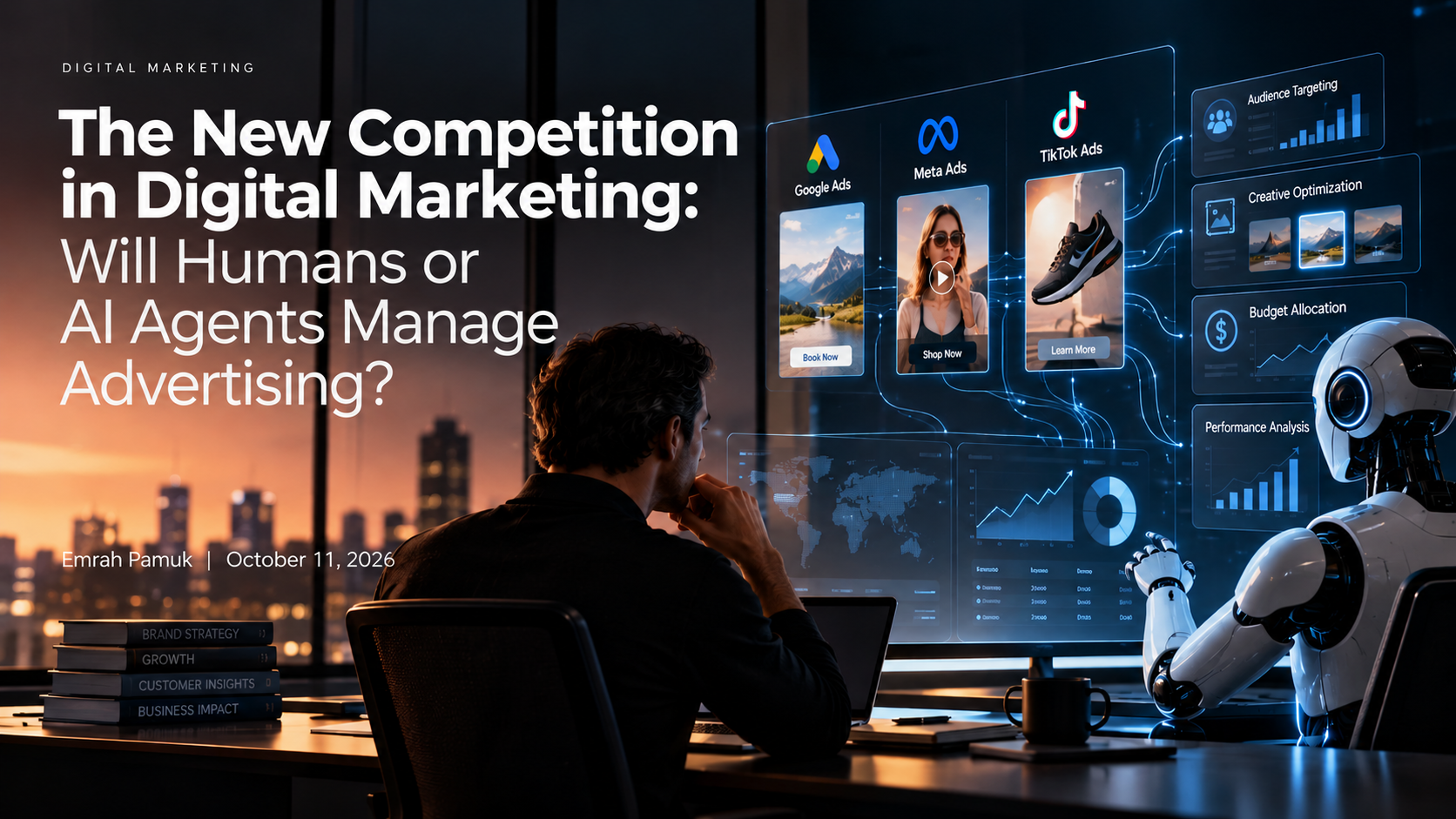
For many years, digital advertising was an industry where professionals competed based on their ability to target the right audiences, allocate budgets efficiently, and reach potential customers at the right moment.
Today, the rules of that competition are changing.
Defining campaign audiences, optimizing bidding strategies, generating advertising copy, and reallocating budgets based on performance no longer require human intervention at every stage.
Artificial intelligence can already handle a significant portion of these processes. More importantly, it can continuously analyze data and operate at a scale that would be extremely difficult for humans to manage manually.
But this transformation raises a much bigger question:
When artificial intelligence begins managing advertising operations, what will be the real value of digital marketing professionals and agencies?
I believe this will become one of the most important discussions in our industry over the next few years.
Because the future of digital marketing is not simply about introducing more automation.
It is about who makes marketing decisions, which data informs those decisions, and how they contribute to a company’s commercial objectives.
Advertising Platforms Are Becoming Decision-Making Systems
When we look at the evolution of platforms such as Google, Meta, and TikTok, we can identify a common direction: an increasing share of advertising management is being delegated to AI-powered systems.
Google’s AI Max approach helps advertisers identify opportunities beyond traditional keyword targeting, adapt advertising content to user intent, and select relevant landing pages.
TikTok’s Smart+ solutions expand automation across targeting, creative optimization, and budget management while providing advertisers with different levels of control.
Meta’s Advantage+ solutions similarly allow advertisers to leverage machine learning more extensively in campaign optimization.
These technologies are not identical. Each platform has different capabilities, data sources, and automation limitations.
It is also important to recognize that not every automated advertising system qualifies as an autonomous AI agent.
Nevertheless, they are all part of the same transformation.
Advertising platforms are evolving from tools that execute human instructions into systems capable of making optimization decisions within defined boundaries.
And this shift will fundamentally change where economic value is created in advertising management.
What Will AI Agents Actually Change in Advertising?
Most advertising automation systems currently focus on optimizing specific tasks.
AI agents represent a broader approach.
An AI agent can potentially plan multiple steps toward a defined objective, interact with different tools, evaluate outcomes, and take further actions within authorized limits.
Consider the digital marketing operations of a hotel.
The hotel’s management wants to increase direct bookings from a particular international market over the next month.
An AI agent system working toward this objective could theoretically analyze market demand, review historical campaign performance, recommend advertising budgets, develop creative alternatives, test different approaches, and suggest optimizations based on results.
In a more advanced environment with the necessary integrations, the system could also execute certain actions autonomously within approved boundaries.
However, there is an important distinction.
Such end-to-end capabilities are not universally available as complete, ready-to-use solutions across today’s advertising platforms.
They require data integrations, permissions, reliable measurement, and human oversight.
Still, this example illustrates where the industry is heading.
As the operational workload of advertising management decreases, the importance of marketing strategy does not disappear.
In fact, it becomes even more critical.
AI Can Optimize Advertising. But Can It Understand a Company’s Real Business Priorities?
This is where I believe the conversation becomes particularly interesting.
A successful advertising campaign and a genuinely growing business are not necessarily the same thing.
An e-commerce brand, for example, might report an excellent return on advertising spend.
But if most of those sales come from customers who were already familiar with the brand, the campaign’s incremental contribution to growth may be limited.
Similarly, a hotel might generate bookings at a relatively low acquisition cost.
However, profitability, cancellation rates, customer profiles, and the impact on other distribution channels could reveal a very different commercial picture.
An AI system can become extremely effective at optimizing the objective it has been given.
But optimizing the wrong objective more efficiently does not mean the company is moving in the right direction.
One of the greatest risks in AI-driven marketing will not simply be artificial intelligence making incorrect decisions. It will be humans giving AI the wrong objectives and allowing it to optimize them exceptionally well.
This is why future marketing leaders will need to understand much more than advertising platforms.
They will need a stronger understanding of finance, customer behavior, data quality, and business growth models.
The Real Transformation of Marketing Agencies Is Just Beginning
For years, digital marketing agencies have built their service models around campaign setup, optimization, reporting, and media buying operations.
Many of these activities still require significant expertise.
However, repetitive tasks and processes governed by clearly defined rules are becoming increasingly easier to automate.
As a result, competing primarily on operational capacity may become more difficult for agencies.
I believe two different approaches will become increasingly visible.
On one side, there will be agencies using AI tools primarily to deliver their existing services faster.
On the other, there will be companies integrating artificial intelligence into data management, technology, media strategy, customer experience, and commercial growth.
I believe the second approach has greater potential to create a sustainable competitive advantage.
Because clients do not simply need advertising campaigns delivered more quickly.
They want to understand how their marketing investments contribute to their businesses.
This is where the agency’s role begins to expand from campaign management toward growth management.
And the value of a marketing professional will increasingly be measured not by the number of campaigns they launch, but by their ability to demonstrate which decisions contribute to business growth.
A New Division of Responsibilities Between Humans and AI
I do not believe this transformation will completely remove humans from advertising management.
However, I do believe their responsibilities within the system will change significantly.
AI agents may increasingly handle data analysis, campaign monitoring, repetitive optimizations, performance anomaly detection, and the production of certain creative variations.
Human professionals, meanwhile, will need to devote greater attention to brand strategy, commercial objectives, creative direction, budget risks, ethical considerations, and ultimate accountability.
Of course, this distinction will not be absolute.
Artificial intelligence can contribute to strategic analysis, just as humans will continue to intervene in operational decisions.
The real challenge will be identifying which responsibilities are best handled by each.
Human oversight will remain particularly important in areas such as brand safety, personal data protection, measurement accuracy, and uncontrolled advertising expenditure.
Successful automation requires more than powerful technology.
It requires reliable data, clearly defined objectives, decision-making boundaries, and a governance model that allows human intervention when necessary.
How Much Should We Trust the AI Systems Built by Advertising Platforms?
There is another important issue that deserves attention.
Advertising platforms sell advertising inventory while also developing the algorithms responsible for optimizing spending on that inventory.
This does not automatically mean their algorithms are ineffective or unreliable.
However, it does reinforce the importance of independent measurement.
A campaign that performs well according to a platform’s reporting system may not generate the same level of value when evaluated against a company’s overall profitability.
Attribution models, repeat purchases, and interactions between marketing channels cannot always be fully understood through a single advertising platform’s reporting environment.
For this reason, I believe businesses should continue investing in their own data infrastructure.
First-party customer data, CRM systems, analytics platforms, sales results, and financial performance indicators should be evaluated together.
As we delegate more authority to artificial intelligence, independently validating the data and understanding the consequences of automated decisions will become even more important.
What Will Digital Marketing Look Like Between 2027 and 2029?
Looking ahead to the next three years, I see several developments that could reshape the industry.
First, campaign setup will become increasingly simplified.
Advertisers will spend more time defining business objectives, while AI-powered systems take greater responsibility for operational execution.
Second, creative production and media optimization will become more closely connected.
Advertising content will no longer be created exclusively by humans and then uploaded to platforms. Performance data will increasingly influence the creative production process itself.
Third, agency pricing and service models will face pressure to evolve.
Operational hours may become less important as strategic contribution, technology infrastructure, and measurable business outcomes receive greater attention.
Fourth, independent data and measurement capabilities will become more valuable.
Businesses will need stronger visibility into what their advertising investments actually contribute beyond the metrics reported by individual platforms.
Finally, business knowledge will become just as important as technological expertise for marketing professionals.
These are not guaranteed outcomes. They are my expectations based on the current direction of technological development and the advertising industry.
But one thing is clear to me:
Artificial intelligence is not simply forcing digital marketing professionals to work faster.
It is forcing them to think differently.
Conclusion: The Real Question Is Not Who Manages Advertising, but Who Defines the Strategy
The next phase of competition in digital advertising will not simply be a battle between humans and artificial intelligence.
The real competition will be between companies that use AI primarily to accelerate operations and those capable of transforming it into a growth system built on the right data and strategy.
Launching an advertising campaign is already significantly easier than it used to be.
Over the coming years, optimizing those campaigns will likely become easier as well.
But choosing the right market, understanding customers, defining brand positioning, managing investments, and achieving sustainable growth will remain serious management challenges.
For me, the marketing professional of the future will not be someone who competes against artificial intelligence.
It will be someone who knows how to direct artificial intelligence toward the right questions, objectives, and decisions.
Because no matter how advanced technology becomes, the most important competitive advantages in business will continue to come from making the right decisions.
The winners in the future of advertising will not be those who manage the most campaigns, but those who make the smartest growth decisions.